Welcome to AgroNepal.Blogspot.Com to all the visiters.This blog is completely dedicated for the updated info about the Agriculture/Agricultural Technology.
Your Ad Here
Showing posts with label Nepal's Agriculture History. Show all posts

Saturday, September 4, 2010

Agriculture Equipment in Nepal

Mechanization of agriculture in Nepal is at very low level, which means that Nepal is still using the traditional Equipment and traditional ways of Agriculture. Af first, there were about 315.1 thousand holdings using the most common agricultural equipment like iron plough in 1991/92 whereas this number increased  upto 870.3 thousand holdings in 2001/02. 
Tractor

 Tractor is used to describe the distinctive farm vehicle which deliver a high tractive effort (or torque) at slow speedsThe use of tractors has been increasing slowly. From 1.2 percent of the total holdings using tractors in 1991/92 and it increased upto 8.2 percent in 2001/02. 

Thresher
Thresher/Threshing machine(a device that first separates the head of a stalk of grain from the straw, and then further separates the kernel from the rest of the head) occupies a very important place among equipment used in farming operation. The use of thresher in farming operation has also been increasing from 3.2 percent of the total holdings using it in 1991/92 and increased to 7.5 percent in 2001/02.
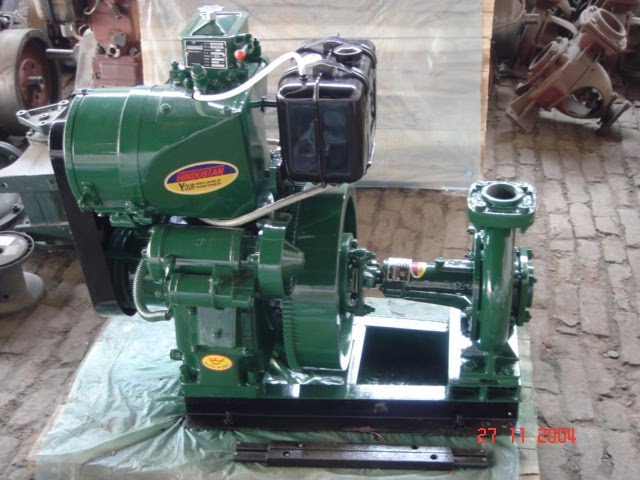
Pumping set
 Pumping set, which is also very important agricultural equipment for the purpose of irrigation, has increased from 3 percent holdings using it in 1991/92 to 6.3 percent holdings in 2001/02. Though farm mechanization in Nepal is still at incipient stage, there are indications of improvement. 

Use of equipment such as power tillers, sprayers, rower pumps is on the rise also.  However, the number of animal drawn carts has stagnated over the decade.  

Nepal's Agriculture History

In Nepal, prime economy of the citizens is Agriculture. Due to which Nepal is know as the Agricultural Countries in the World. . In the late 1980s, it was the livelihood for more than 90 percent of the population, although only approximately 20 percent of the total land area was cultivable, it accounted for, on average, about 60 percent of the GDP and approximately 75 percent of exports. Since the formulation of the Fifth Five-Year Plan (1975-80), agriculture has been the highest priority because economic growth was dependent on both increasing the productivity of existing crops and diversifying the agricultural base for use as industrial inputs.
According to the World Bank, agriculture is the main source of food, income, and employment for the majority.
In trying to increase agricultural production and diversify the agricultural base, the government focused on irrigation, the use of fertilizers and insecticides, the introduction of new implements and new seeds of high-yield varieties, and the provision of credit. The lack of distribution of these inputs, as well as problems in obtaining supplies, however, inhibited progress. Although land reclamation and settlement were occurring in the Tarai Region, environmental degradation and ecological imbalance resulting from deforestation also prevented progress.
Although new agricultural technologies helped increase food production, there still was room for further growth. Past experience indicated bottlenecks, however, in using modern technology to achieve a healthy growth. The conflicting goals of producing cash crops both for food and for industrial inputs also were problematic.
The production of crops fluctuated widely as a result of these factors as well as weather conditions. Although agricultural production grew at an average annual rate of 2.4 percent from 1974 to 1989, it did not keep pace with population growth, which increased at an average annual rate of 2.6 percent over the same period. Further, the annual average growth rate of food grain production was only 1.2 percent during the same period.

There were some successes. Fertile lands in the Tarai Region and hardworking peasants in the Hill Region provided greater supplies of food staples (mostly rice and corn), increasing the daily caloric intake of the population locally to over 2,000 calories per capita in 1988 from about 1,900 per capita in 1965. Moreover, areas with access to irrigation facilities increased from approximately 6,200 hectares in 1956 to nearly 583,000 hectares by 1990.